
Why nobody can cure your chronic pain
For years, many people go through consultations, treatments, medical tests and various therapies in an attempt to resolve their chronic pain. Sometimes symptoms improve for a few days or weeks, but the problem eventually returns. This leads to frustration, doubt and even the feeling that the pain is now a permanent part of life. However, in many cases the problem is not that there is no solution, but rather that the approach being used is failing to tackle the root cause of the problem. This is where approaches such as functional neurology with the P-DTR therapy begin to make sense when analysing the role of the nervous system in the persistence of pain.
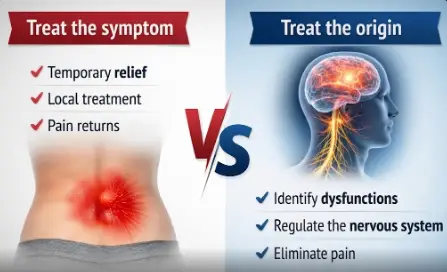
The big problem with chronic pain: the symptom is treated, not the cause
One of the reasons why many people fail to improve or resolve their chronic pain The fact is that most treatments focus on the tissue or the area that is causing pain. They work on the muscle, the joint or the inflamed area, but they do not always analyse what is causing the body to keep that signal active for so long, or whether it might be a consequence rather than a cause. From the perspective of the P-DTR functional neurology, pain does not always depend solely on an injury, but on how your nervous system it interprets the information it receives from the body and adapts to it.
When an injury or an event affecting the body occurs, the body activates protective mechanisms. This is normal and necessary initially. The problem arises when that response persists over time, leading to dysfunctions sensory factors that cause the pain to persist even when the tissue should already have healed. At this stage, working solely on the structure may not be enough to relieve chronic pain, as the origin is still evident in the way in which the nervous system processes bodily information.
And for this reason, the P-DTR neuroreceptor therapy, within the functional neurology, it’s starting to make sense; by analysing the problem from a different perspective: how the body is communicating with the brain.
What happens in the body when pain becomes chronic
When the chronic pain If it persists for months or years, the body will usually have developed compensatory protective patterns. These patterns may include increased muscle tension, a lack of stability, pain, changes in posture, alterations in breathing and changes in the way one moves. All of this is regulated by the nervous system, which seeks to protect a region or area that it perceives as vulnerable.
In many cases, it is not the initial injury that causes the problem to persist, but a series of dysfunctions neurological mechanisms that amplify the pain signal; to put it another way sensitised sensory receptors. This explains why some people with abnormalities detected in medical tests do not experience pain, whilst others with minor lesions – or even no lesions at all – do develop chronic pain persistent.
The functional neurology It examines precisely these bodily responses and how they have changed over time. Through the neuroreceptor therapy, the receptors that relay information to the brain about pressure, movement, load or joint position are examined. When any of these receptors malfunctions, the brain may interpret danger where there is none.
The P-DTR system focuses on identifying these altered responses so that to eliminate chronic pain by adjusting the signal that keeps the alert active.
Why do some treatments help at first but not in the long term?
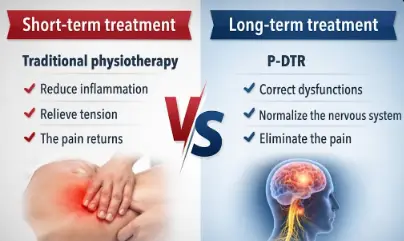
A very common situation amongst people who suffer from chronic pain it is common to feel relief after a physiotherapy session, but for the pain to return over time. This happens because the treatment has reduced tension or inflammation, but has not altered the neurological signal underlying the problem.
When the nervous system, in other words, our body continues to interpret the situation as a threat, and the body reactivates its defence mechanisms. This ultimately leads to the reappearance of pain, muscle spasms, restricted movement or strain in other parts of the body. This is what many people describe as ‘the pain always comes back’.
From the perspective of the functional neurology and the P-DTR system, there is a biological explanation for this phenomenon. The body is not failing; it is trying to protect itself. The problem is that this protective mechanism has remained active for longer than necessary.
That is why approaches such as the P-DTR system they use the neuroreceptor therapy to assess how the nervous system responds to different stimuli and to locate the dysfunctions neurological factors that are keeping the problem active. Once these are corrected, the body stops interpreting the situation as dangerous and can begin to reorganise itself.
The role of the nervous system in maintaining or resolving pain
To understand this, you need to know how the nervous system works.
The nervous system it is responsible for coordinating how the body moves, how the muscles adapt and how protective responses are regulated. When it functions correctly, the body can recover from injuries and return to its normal state. But when there are dysfunctions, the nervous system continues to send out warning signs that keep the chronic pain active.
This does not mean that the pain is imaginary or psychological. It means that the cause may lie in the body’s neurological regulation. The P-DTR functional neurology analyse these responses to understand what is really happening.
The P-DTR system It is based on studying the relationship between the sensory information received by the body and the motor response it generates. If that relationship is disrupted, the body compensates. And it is these compensatory mechanisms that may be responsible for the pain not going away.
Through the P-DTR neuroreceptor therapy, it is possible to identify the receptors that are sending incorrect information to the brain and work to normalise that signal. This enables a gradual relieve chronic pain by removing the cause that keeps it active.
What changes when pain is approached from the perspective of functional neurology
When the chronic pain is analysed from the functional neurology, it completely changes the way we understand the problem. Instead of focusing solely on where it hurts, we look at why the body continues to protect itself and what dysfunctions are keeping that signal active in the nervous system.
This approach makes it possible to detect abnormalities that often go unnoticed in traditional assessments. These dysfunctions may be linked to old injuries, repeated strain, physical stress or changes in the way the body has adapted over time.
The P-DTR system, as part of the work with functional neurology, uses the neuroreceptor therapy to analyse how the nervous system responds and to reorganise the information reaching the brain. When that signal returns to normal, the body stops activating unnecessary protective mechanisms.
This explains why many people who had been living with chronic pain begin to improve when the problem is tackled from this perspective. By correcting the dysfunctions that were keeping the body in a state of alert, the body regains its natural capacity for adaptation and movement. In this way, it is possible to relieve chronic pain and move towards the possibility of to eliminate chronic pain from the outset, rather than merely providing temporary relief from the symptoms.
Did you enjoy the content?
Follow me on social media or read another article!
If you think someone else might like this… Share it!
Related articles
How can I stop my pain from coming back?
What is P-DTR?
What is functional neurology?
Information
Phone
+34 621 079 216
joaquinferrer.fisio@gmail.com
Address
Av. Ángel Nieto, 8, 28660 Boadilla del Monte, Madrid
