
What is P-DTR?
There are people who have been living with pain, discomfort, persistent limitations or problems that other professionals have been unable to resolve for years. They have tried physiotherapy, medication, rest, exercise or even surgery, and yet the problem persists. In many of these cases, the root cause lies not in the structure (muscle, bone, ligament, joint, etc.), but in how the body interprets and processes information. This is where neuroreceptor therapy comes into play. P-DTR created by Dr. José Palomar, an advanced methodology within the functional neurology which enables the identification and correction of errors in the nervous system responsible for the chronic pain, inflammation, primitive reflexes, allergies and other persistent disorders.
What is the P-DTR system and how does it differ from other treatments
The P-DTR system, or P-DTR methodology, is a neuroreceptor therapy designed to detect and eliminate malfunctions in our information receptors that disrupt the body’s normal functioning. Its full name is, Proprioceptive Deep Tendon Reflex, refers to the use of deep and proprioceptive reflexes as a diagnostic and therapeutic tool, utilising the nervous system, which, after all, is what controls the body.
Unlike conventional treatments, the approach taken by functional neurology does not involve treating the symptom directly, but rather understanding why your nervous system continues to maintain protective or threat responses that are no longer necessary. When this happens, the body enters a state of constant alertness, which manifests itself in the form of pain, stiffness, inflammation, fatigue, hypersensitivity…
The P-DTR system is based on a key idea: if the nervous system perceives a threat – whether real or learned – it will alter the way you move, breathe and recover. If that signal is not corrected once the actual injury has passed, the problem becomes chronic and your body compensates, which may lead to other problems.
What is dysfunction and how is it linked to chronic pain
To understand why chronic pain occurs, it is essential to understand what a dysfunction is. A dysfunction is neither a structural injury nor a hereditary condition. It is a breakdown in communication between your sensory receptors and your body’s interpretation of the information.
When a dysfunction occurs, the nervous system interprets normal stimuli as dangerous. As a result, it activates protective mechanisms, including increased muscle tone, changes in breathing, postural changes and a reduced ability to recover. All of this can cause pain without any visible damage being detected in medical tests, but if that pain persists for a long time, it may eventually lead to structural damage due to compensatory mechanisms.
P-DTR neuroreceptor therapy enables these dysfunctions to be accurately identified and desensitised – in other words, eliminated – thereby restoring your nervous system’s ability to self-regulate. This is precisely why it is particularly effective in cases where other treatments have not worked in the long term, whether because you were not properly assessed or because they did not address the root cause of the problem.
How treatment using the P-DTR methodology works, step by step
The P-DTR methodology is based on the direct assessment of neuroreceptors, the structures responsible for informing the brain about the body’s condition. These receptors transmit information relating to movement, stretching, load, pressure, vibration and joint position, and play a key role in how the nervous system interprets whether or not a threat is present.
Functional neurology analyses how the nervous system responds to different stimuli. When a dysfunction is present, the body exhibits reflex responses such as inhibition, weakness or excessive tension. These responses are involuntary, which makes them a highly reliable tool for understanding how and where the system has begun to compensate.
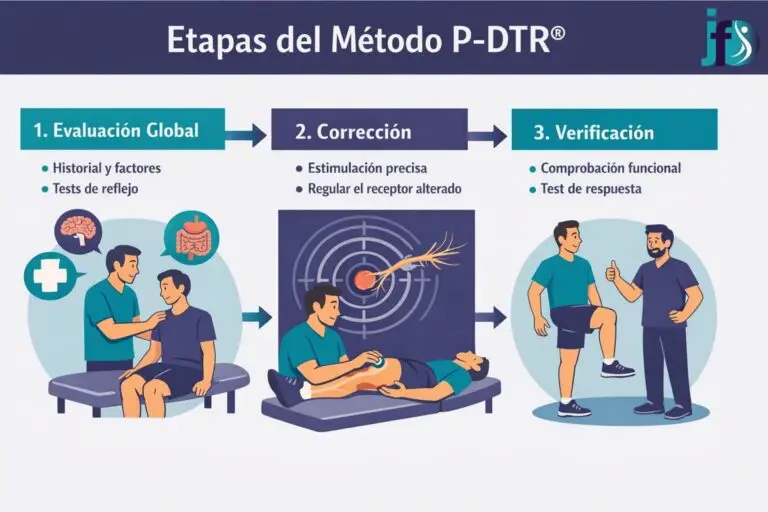
The process begins with a comprehensive assessment, taking into account a history of injuries, emotional factors, digestive issues or other systemic disorders. It is not simply a matter of identifying where the pain is, but of understanding what has happened in the nervous system to cause that symptom. Through myotatic reflex tests, we identify how the body has adapted and where the cause lies.
Once the dysfunction has been identified, the treatment moves on to the correction phase, applying specific, precise and controlled stimuli to the affected receptors. The aim is not to force the body, but to show the nervous system that there is no longer a real threat. When this new information is integrated, the defensive response subsides and the pain or associated symptom is reduced or disappears.
Finally, an objective assessment of the change is carried out, checking that the body responds normally to stimuli that previously caused pain or weakness. This confirms that the improvement is not merely subjective, but that there is a genuine normalisation of function and proprioceptive processing, leading to stable and long-lasting results.
What conditions can the P-DTR system treat?
One of the major advantages of the P-DTR system is that it is not limited to a specific type of condition. As it addresses functional dysfunctions, it can help in a wide variety of cases.
Chronic pain is one of the most common reasons for seeking medical advice. People with acute or chronic pain in the lower back, neck, shoulder, knee, foot or jaw who are unable to find a solution often see an improvement once the underlying cause of the problem has been addressed.
It is also possible to treat intolerances and allergies using P-DTR neuroreceptor therapy. In many cases, these reactions are not explained solely by a primary immune disorder, but rather by a learned defensive response of the nervous system, modulated by:
- Persistent nociceptive afferents
- Regulatory imbalance at the regional level, particularly of the adrenal axis and the digestive system.
- Abnormalities in taste receptors and lingual afferents
- Digestive system disorders: a key factor in food tolerance.
- Unresolved emotional stress that influences the neuroimmune response.
P-DTR aims to normalise the altered related information and reduce the nervous system’s inappropriate defensive response to stimuli that should not trigger a reaction. This approach neither replaces nor contradicts genetically-based allergies. In some cases, there may be structural or organic factors, which must be assessed and ruled out, but 95 per cent of cases are functional and treatable with functional neurology.
Other areas where functional neurology is particularly effective include conditions such as fibromyalgia, migraines, persistent fatigue, long-term emotional disturbances and difficulties in recovering from an injury. In all these cases, the aim is the same: to eliminate dysfunctions so that the body can function normally again.
P-DTR functional neurology versus conventional physiotherapy
Physiotherapy is an essential tool when there is a structural injury and the tissue needs to be repaired, protected or rehabilitated. However, when the root cause of the problem is functional, its effectiveness may be limited. In such cases, many people experience temporary relief, but the pain or symptom returns because the nervous system continues to perceive a threat, even though the structure has already healed.
In clinical practice, this often occurs when the approach focuses on alleviating symptoms without identifying which system is triggering the defensive response. The body improves, but the neurological pattern that caused the problem remains active.
P-DTR functional neurology does not replace physiotherapy, but rather complements and enhances it. Its unique value becomes apparent when the root cause of the problem lies in systems that are not usually assessed in conventional physiotherapy, such as the digestive system, the autonomic nervous system or emotional factors. For this reason, more and more people are turning to functional neurology when seeking to understand the real cause of their problem and achieve lasting changes, rather than merely symptomatic relief.
Why P-DTR is changing the way we understand pain
The P-DTR methodology, based on functional neurology, represents a profound shift in the way we understand pain and bodily dysfunctions, and in the treatment of chronic pain. Rather than focusing on adapting to the symptom or learning to live with it, this approach enables us to understand why the nervous system maintains that response and to address its root cause.
When dysfunctions within the nervous system are corrected, the body can reorganise its defensive responses and regain more efficient function in terms of movement, breathing and recovery. The aim is not to ‘silence’ the pain, but to eliminate the system’s need to generate it.
For many people, this approach represents the first real step towards lasting improvement, especially when they have tried other treatments without addressing the root cause. If you have been searching for answers for some time, you may not need more techniques, but rather the right approach for your nervous system.
If you have any queries or would like to discuss your case, you can contact me and we assess it from a clinical perspective.
Did you enjoy the content?
Follow me on social media or read another article!
If you think someone else might like this… Share it!
Related articles
What is functional neurology?
How P-DTR relieves pain
Why nobody can cure your chronic pain
Information
Phone
+34 621 079 216
joaquinferrer.fisio@gmail.com
Address
Av. Ángel Nieto, 8, 28660 Boadilla del Monte, Madrid
