
How can I stop my pain from coming back?
Getting past the painful stage of a condition is just the start of your recovery process. If you have suffered from various biomechanical issues, you should be aware that simply getting rid of the symptoms does not mean the problem has been fully resolved. To prevent the symptoms from returning over time or during physical exertion, it is necessary to adopt a personalised approach tailored to you, using functional neurology to pinpoint the neurological origin of the problem by directly assessing the nervous system.
In this article, discover how a personalised, non-invasive approach is the key to resolving your pain once and for all.
How to address the cause of my pain
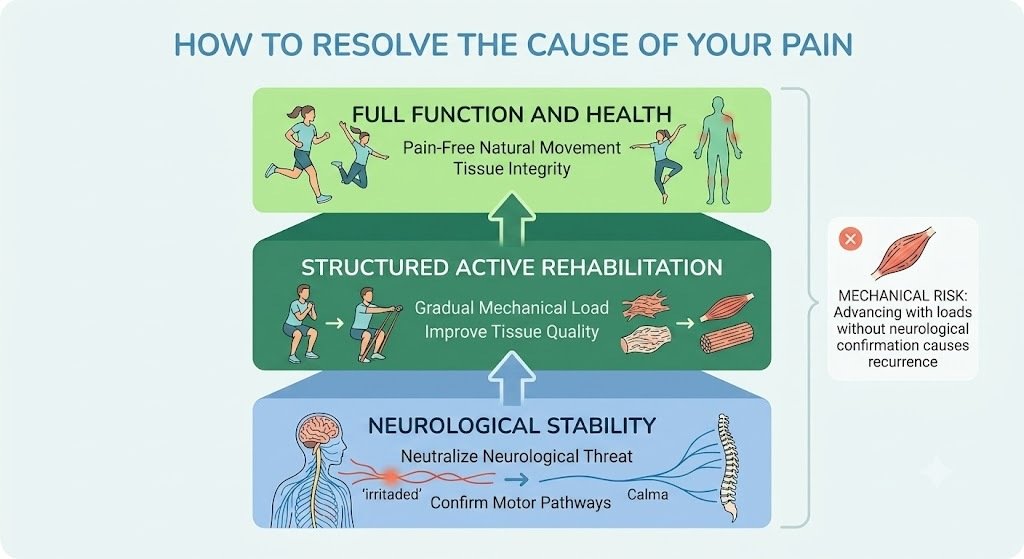
Effective treatment of chronic pain requires identifying which neuroreceptors are hypersensitised and sending aberrant afferent signals of threat to the brain. By applying the P-DTR technique, we normalise these nerve endings. However, following this initial phase, the connective tissue remains unadapted to mechanical load. Unless a structured programme of rehabilitation or re-education is immediately prescribed, the mechanical risk to the joint persists. Prolonged poor tissue quality leads to a lack of information and support for the surrounding structures. This lack of direct physical support is the main cause of recurrence in patients who are discharged prematurely. Our primary objective is to restore full function without causing any secondary compensatory dysfunction in the patient’s musculoskeletal system.
The first, non-negotiable step in any treatment is to neutralise the neurological threat that causes tissue to be poorly oxygenated, inactive or lacking in support. As healthcare professionals, we know that once we have addressed the cause of the pain using functional neurology and assessed your proprioceptive and exteroceptive (visual-vestibular) systems—and confirmed that everything is functioning correctly—the physical, metabolic and neurological landscape changes dramatically. At this precise point in the intervention, your nervous system ceases to perceive your own joint movement as an imminent threat to tissue integrity.
Chronic pain disappears because the cerebral cortex withdraws the command for uninterrupted defensive muscle contraction or begins to activate the fibres that were previously inactive. By applying the P-DTR diagnostic and therapeutic technique, we have resolved the direct interference in nerve communication. However, a muscle that has been neurologically inhibited or hyperactive for an extended period loses much of its capacity for normal physiological contraction. The start of the active rehabilitation phase must be based exclusively on this new neurological stability acquired during the consultation. Proceeding with weight-bearing exercises without this confirmation is likely to result in a short-term biomechanical relapse. It is essential to confirm, through clinical tests, that there is no residual neurological dysfunction in the motor pathways.
How the body adapts to movement
With the central and peripheral nervous systems properly recalibrated, the patient no longer experiences limiting symptoms whilst at complete rest. Having reached this stage, we now need to observe how your body moves and adapts to movement; to do this, we will carry out a series of tests to identify any dysfunctions or compensations. The principles of functional neurology dictate that simply observing an individual at rest is insufficient to guarantee long-term joint health, as we are not defined solely by our posture.
Patients who have endured a long period of chronic pain exhibit clear neuromotor abnormalities in their basic movement patterns, such as the biomechanics of walking, sitting or prolonged standing. The P-DTR assessment methodology provides us with highly accurate diagnostic tools to evaluate how the skeletal and muscular structures respond to progressive dynamic loads. A comprehensive rehabilitation programme utilises these objective metrics to design the subsequent physical intervention. If we fail to subject soft tissue to increasing kinetic demands, the mathematical probability of suffering a further structural recurrence rises exponentially. By quantifying deficits in isometric and eccentric joint strength, we avoid overloading the ligaments and prevent the onset of any compensatory motor dysfunction during physical exercise.
Stages of neuromuscular rehabilitation
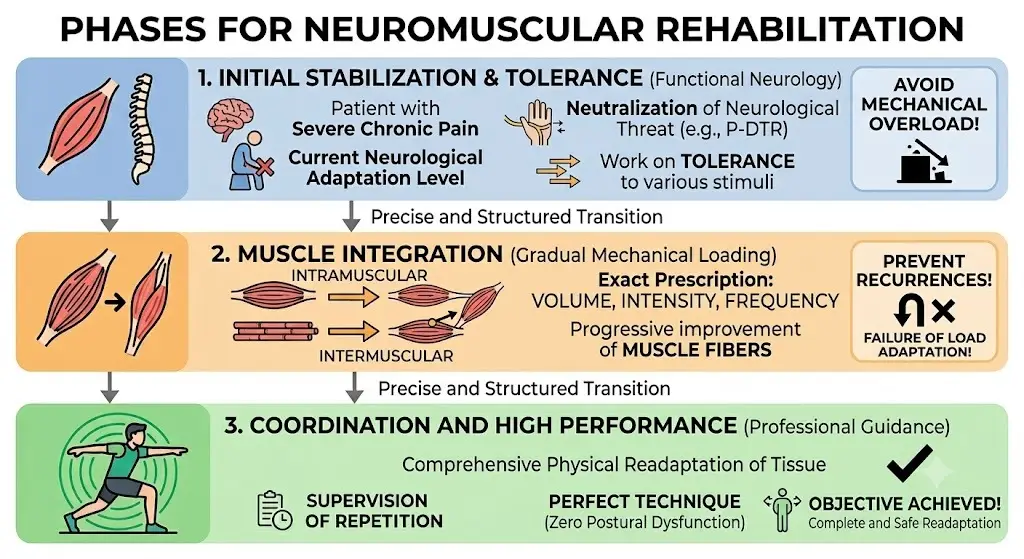
The comprehensive physical rehabilitation or re-education of tissue requires progressing through specific, structured stages. It is necessary to work on tolerance to different stimuli, the capacity for intermuscular and intramuscular integration, and coordination. These three areas of intervention represent the fundamental pillars of functional neurology as applied to high-performance therapeutic exercise. A patient with a clinical history of severe chronic pain cannot undertake conventional physical training programmes without first adapting the mechanical load to their current neurological condition, as this could aggravate the condition or lead to relapses.
Assessment sessions using P-DTR ensure a more effective and efficient response, but muscle fibres must be strengthened progressively. The success of the rehabilitation phase lies in the precise prescription of the volume, intensity and frequency of mechanical training. Ignoring the biological and physiological principles of tissue adaptation inevitably leads to a painful relapse caused by mechanical overload of the joint. The practitioner in charge must guide and supervise each repetition to ensure that the patient’s joint moves perfectly, completely ruling out any postural dysfunction during the technical execution of the movement.
What happens when tolerance to stimuli increases?
The first phase of structural reconditioning aims to directly strengthen the connective tissue, tendons and the muscular fascia itself. Subjecting the anatomical structure to axial forces, eccentric loads and shear forces in a meticulously controlled manner is a basic and fundamental principle of functional neurology. After months or years of suffering from uninterrupted chronic pain, your tendons and ligaments have lost a significant amount of collagen density, whether due to complete disuse or to sustained hypertonicity maintained by the nervous system.
Thanks to the precise neurological corrections carried out beforehand using P-DTR, the brain now allows these peripheral structures to bear mechanical load without triggering immediate defensive joint locks. This initial phase of active rehabilitation requires very strict control of the external load to prevent any form of secondary tissue inflammation. Progressively increasing the tissue’s capacity to absorb mechanical impacts is the best-documented strategy for eliminating the risk of recurrence in sporting or occupational contexts. If the striated muscle cannot tolerate the actual mechanical stress to which it is exposed, the nervous system will generate an immediate compensatory dysfunction to protect the integrity of the joint, thereby restarting the original neurological injury cycle.
Effective muscle rehabilitation
Having a well-developed abdominal musculature in isolation does not in any way guarantee the biomechanical stability of a complex human joint. The second stage of recovery requires restoring the coordination of all fibres, both intramuscular and intermuscular, which is why we focus on complete neuromuscular integration. The biomechanical approach from the perspective of functional neurology emphasises that efficient human movement requires the simultaneous electrical activation of entire muscle chains.
People who have suffered from prolonged episodes of chronic pain often exhibit gluteal amnesia, severe inhibitions in the abdominal belt or diaphragmatic blockages, disrupting the entire pelvic and spinal statics. The precise diagnostic application of P-DTR pinpoints these exact kinetic disconnections. In advanced rehabilitation, we use complex multi-joint exercises in which the nervous system must mechanically distribute the load across different bony levers. Ensuring that various stabilising muscle groups work in perfect synergy is vital to prevent structural recurrence under conditions of intense physical fatigue. Absolute motor efficiency prevents a secondary muscle from erroneously taking over the role of a primary stabiliser, thereby avoiding any dysfunction caused by prolonged mechanical overuse.
How to improve motor coordination
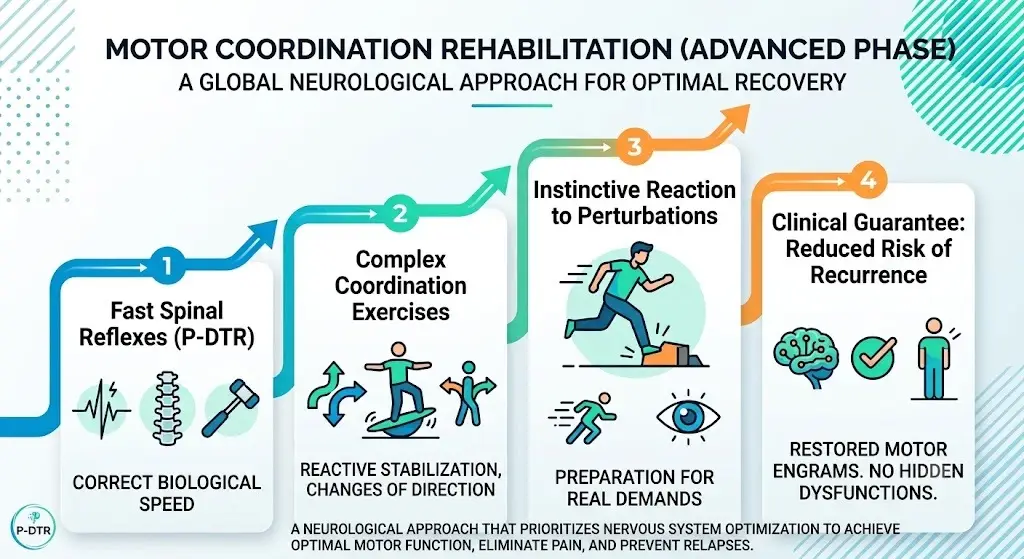
The highest and final stage of recovery requires extreme refinement of the afferent and efferent pathways throughout the nervous system. A patient who has completely eradicated their chronic pain must necessarily regain the capacity for an instinctive reaction to unexpected external disturbances. Strictly adhering to the physiological principles of applied functional neurology, we introduce exercise programmes focusing on reactive stabilisation, changes of direction and immediate postural adjustments.
Prior treatment using the P-DTR technique ensures that spinal myotatic reflexes operate at the correct biological and physiological speed, without any abnormal delays in the transmission of electrical impulses. This final, advanced phase of rehabilitation prepares the individual for the high, real-world and unpredictable demands of the everyday physical environment or sporting activity. Consolidating highly technically complex motor patterns in the brain drastically reduces the statistical likelihood of suffering a joint recurrence following an accidental stumble or a sudden physical exertion. The total and absolute restoration of the brain’s motor engrams is the definitive clinical guarantee that your physical body functions without being limited by any hidden anatomical dysfunction.
Stabilising muscle tissue in the long term
Professional care must always go a step further than the mere temporary relief of symptoms that patients initially seek. The genuine and definitive healing of tissues requires a holistic healthcare approach, firmly grounded in the physiological and biomechanical principles of advanced functional neurology. Resolving the constant initial threat signal that perpetuates the chronic pain condition is merely the first anatomical step in recovery.
By using the P-DTR diagnostic methodology, we re-establish perfect electrical communication between your various peripheral joint receptors and your motor cortex. From that point onwards, active strength training and rehabilitation become essential for consolidating and maintaining, over time, the significant neurological results previously achieved on the treatment table. Progressively exposing the various musculoskeletal structures to mechanical loads, re-educating the contractile synergy of the tissue and refining the coordinated reflex response are essential biological processes.
If we fail to strengthen and coordinate the tissue, and to increase its load-bearing capacity, residual joint instability will inevitably lead to a recurrence of the condition in the near future. Performing dynamic, stable, biomechanically powerful body movements that are entirely free from physical restrictions provides clinical evidence that the body has overcome any neuromechanical dysfunction. This level of control guarantees complete tissue recovery that is permanent and highly resistant to the demands of daily physical activity.
If you find yourself in a situation where your chronic pain has become a real burden and you’re only being treated with generic, conventional methods… it’s time for a change!
Did you enjoy the content?
Follow me on social media or read another article!
If you think someone else might like this… Share it!
Related articles
What is P-DTR?
What is functional neurology?
Why nobody can cure your chronic pain
Information
Phone
+34 621 079 216
joaquinferrer.fisio@gmail.com
Address
Av. Ángel Nieto, 8, 28660 Boadilla del Monte, Madrid
