
What is functional neurology?
Do you suffer from chronic pain that won’t go away, even after you’ve had an operation?
When you feel that conventional physiotherapy is not enough to relieve your chronic pain, it is necessary to change your approach and analyse how your body and nervous system process the information from your sensory receptors.
Throughout this article, you will gain an understanding – both from a clinical perspective and through practical examples – of what functional neurology is and why assessing your neuroreceptors is the best clinical approach to permanently eliminating your chronic pain.
The fact is that there are already millions of patients worldwide who are pain-free thanks to this therapy, and thousands have been treated with functional neurology in Madrid. We will therefore explain how the methodology P-DTR, the most advanced neuroreceptor therapy, normalises your body’s reflex activity and resolves your problem.
How the nervous system reacts to chronic pain
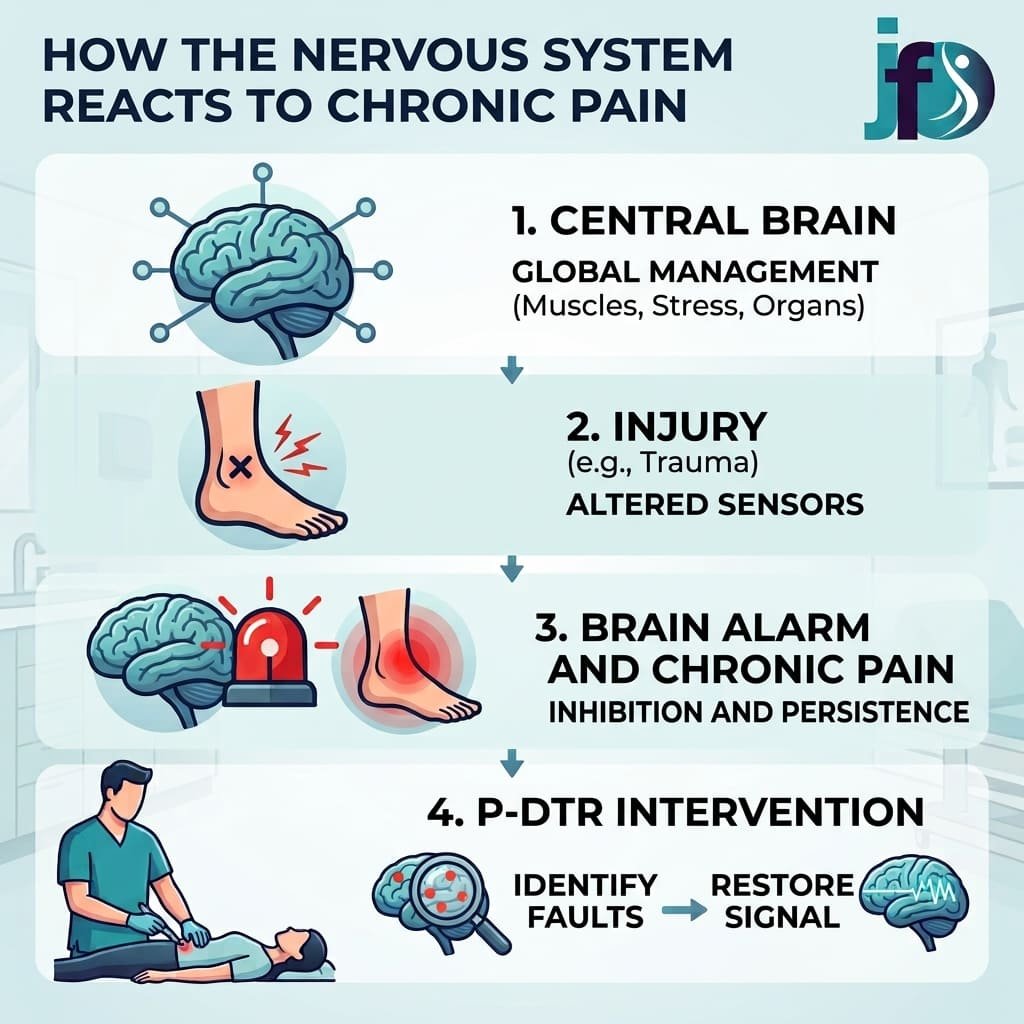
The brain is the organ responsible for managing a multitude of tasks – such as stress, muscle function and organ function – on a continuous basis. P-DTR functional neurology rigorously studies how the brain receives, processes and responds to mechanical, chemical, thermal and emotional stimuli.
When a ligament or tendon sustains an injury, such as a sprain, the threshold at which peripheral sensors are triggered may be altered. This change causes the brain to order constant muscle inhibition in order to avoid putting further strain on the area, but the problem is that when you return to normal activity, you find the joint more unstable and less controllable, making you more prone to long-term or chronic problems.
That is why the first – and most important – step we take at our specialist functional neurology practice in Madrid is to identify which receptors – the sensors that gather information – are failing to transmit this sensory information to your central nervous system, thereby creating the constant threat and the problem.
Sending and receiving information to and from the brain
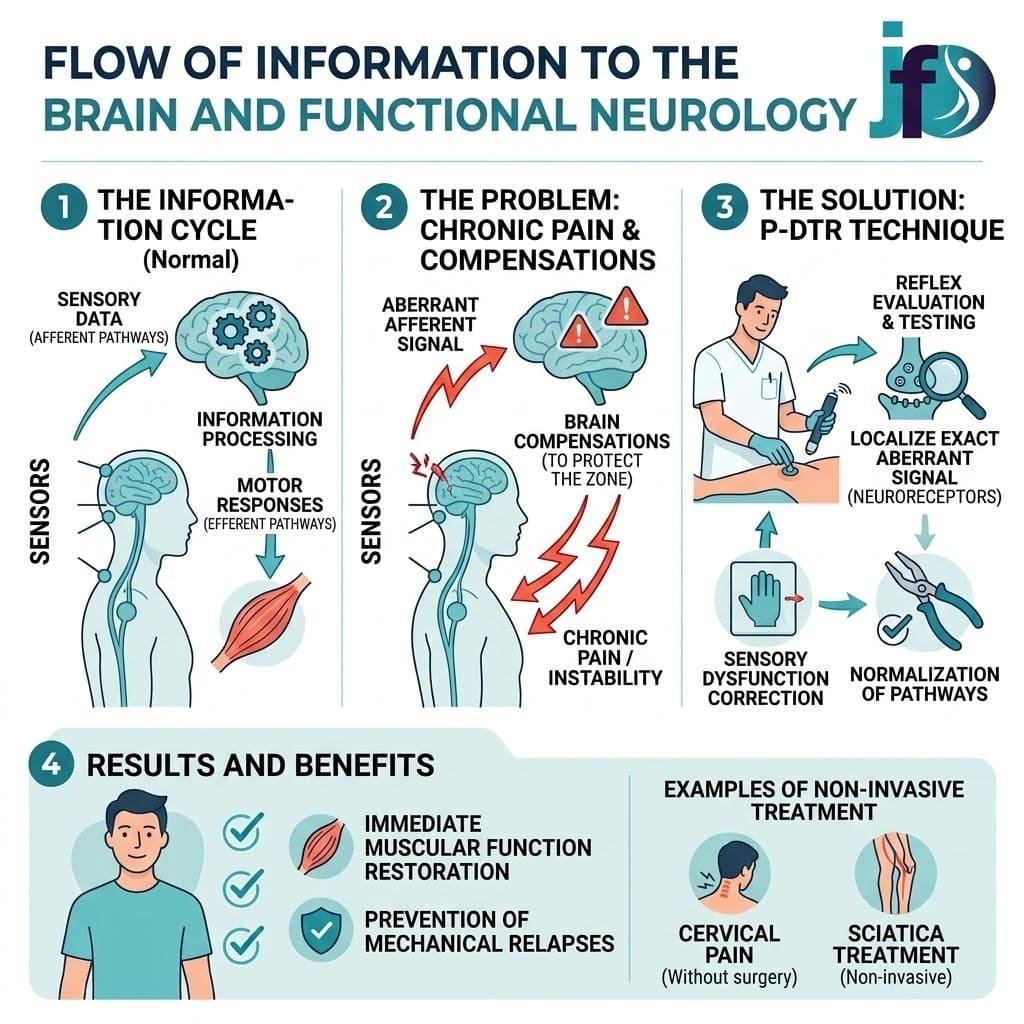
At a neurological level, the human body uses afferent pathways to transmit sensory data, processes the information, and uses efferent pathways to execute motor responses. In functional neurology, if the afferent information or the way in which it is processed is abnormal, the brain will generate compensatory mechanisms to protect the area, thereby perpetuating your chronic pain. With this in mind, patients undergoing treatment with functional neurology in Madrid are already aware of the importance of assessing this afferent pathway and the processing involved.
Using the P-DTR technique, we test the reflexes of your somatosensory system. This neuroreceptor therapy pinpoints the exact aberrant signal. Unless this sensory dysfunction is corrected, the patient will suffer from systematic mechanical relapses. Ultimately, this approach enables us to provide treatments such as, for example, non-surgical treatment for neck pain and non-invasive treatment for sciatica, amongst others; ensuring the normalisation of these pathways and immediately restoring muscle and tendon function.
What distinguishes functional neurology from conventional physiotherapy?
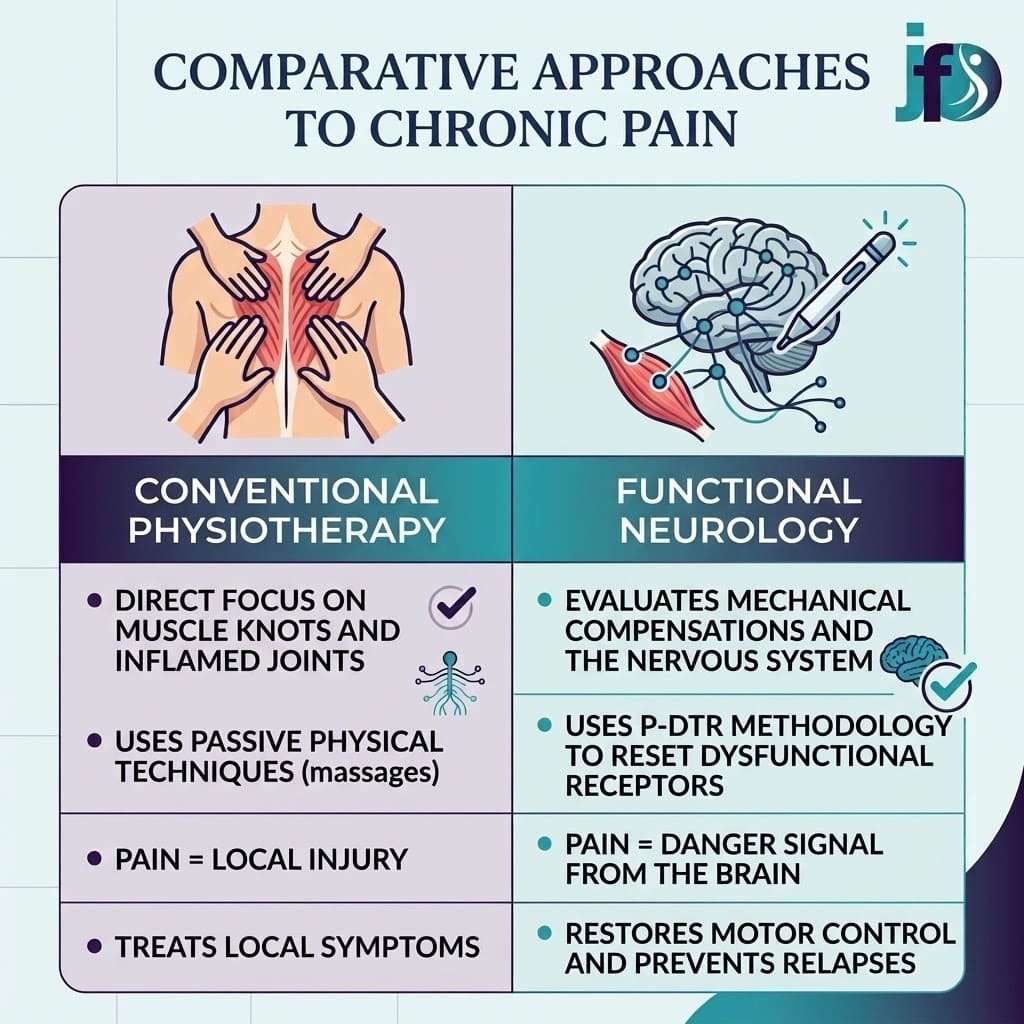
Traditional physiotherapy prioritises treating tight tissue or an inflamed joint using direct, passive physical techniques. However, functional neurology defines muscle tightness and localised inflammation solely as a mechanical compensation mechanism. Your nervous system inhibits some muscles and overworks others to stabilise your body in response to a stimulus it perceives as dangerous, thereby causing your localised chronic pain.
In our day-to-day approach to functional neurology in Madrid, we do not perform deep massage on hyperactive muscles; rather, we assess the peripheral nociceptors and mechanoreceptors that force your cerebral cortex to maintain that state of defensive muscle contraction or uninterrupted inhibition over time.
The origins of structural compensation
The moment the brain processes a threat signal relating to a joint, it automatically inhibits the muscles. Functional neurology focuses on resolving this neuromotor inhibition to address your underlying chronic pain. To do this, we use the P-DTR methodology to reset the dysfunctional (sensitised) receptor. This precise neuroreceptor therapy recalibrates the afferent signal of constant danger. If this alert in the brain is not eliminated, biomechanical relapses will recur with any sustained physical exertion. Consequently, achieving, for example, non-invasive treatment for knee pain or epicondylitis requires restoring motor control and normalising the activation threshold of the primary sensory receptor manually, clinically and painlessly.
Why are neuroreceptors important?
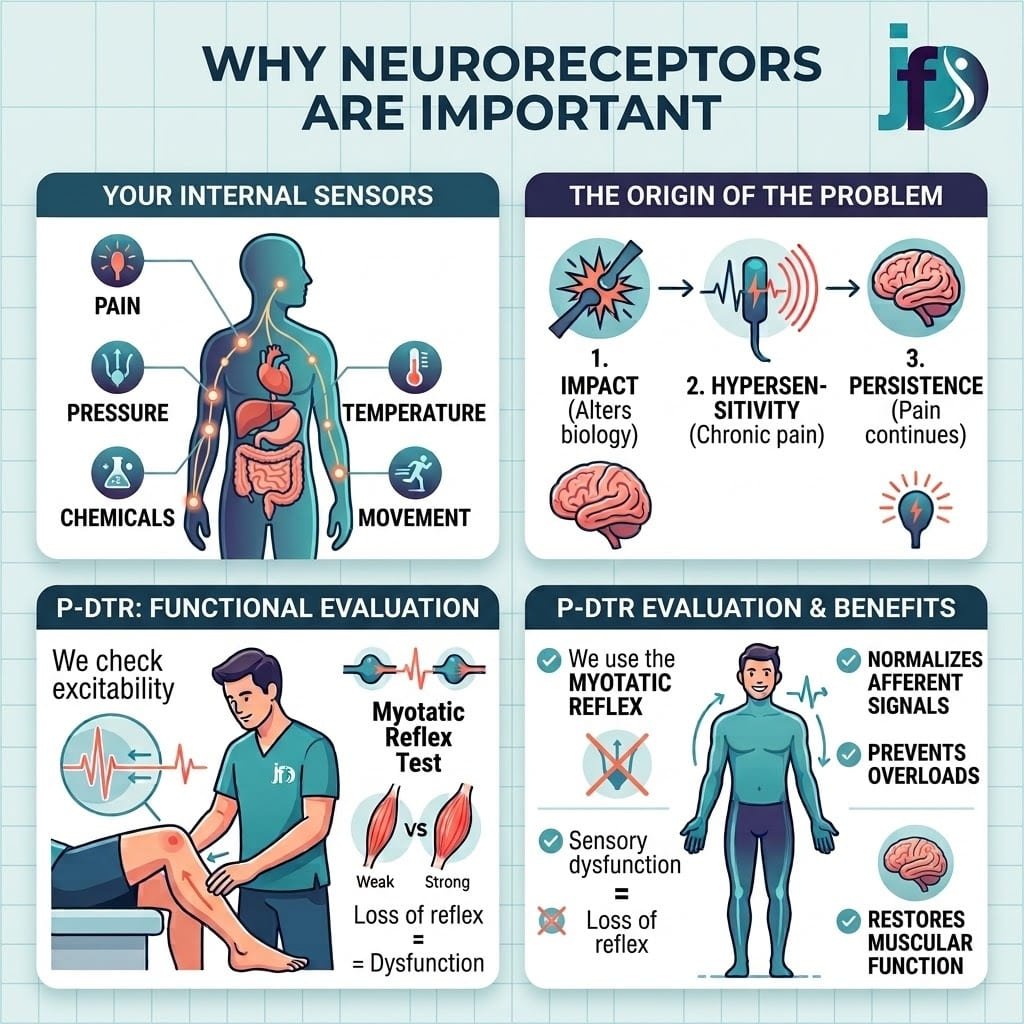
Every millimetre of your fasciae, ligaments, skin and joint capsules contains nociceptors, baroreceptors, chemoreceptors, thermoreceptors and mechanoreceptors that constantly monitor your condition. Using P-DTR functional neurology, we analyse which of these nerve endings is sending an excessive electrical frequency or action potential to the central nervous system. A physical, chemical or thermal impact alters their original biological calibration, causing a state of hypersensitivity that perpetuates chronic pain indefinitely, even though the initial structural damage to the tissue has already healed completely. At our functional neurology clinic in Madrid, we assess the biological excitability threshold of these nerve sensors directly through myotatic reflex tests to pinpoint the exact location of your dysfunction.
The assessment of the reflex myotatic response
We use the myotatic reflex as a direct physiological indicator of afferent integrity. In functional neurology, if the muscle loses its reflex capacity when a peripheral receptor is manually stimulated, we confirm the sensory dysfunction causing your chronic pain. With P-DTR neuroreceptor therapy, which is completely painless, aberrant afferent signals are normalised, we prevent tissues from bearing excessive loads and we halt ongoing joint recurrences. Therefore, non-surgical treatment of plantar fasciitis or non-invasive treatment of patellofemoral syndrome are possible, based biomechanically on the immediate restoration of normal muscle tone.
What is the real impact of scars on our bodies?
Scars, far from being merely a consequence of surgery, drastically alter the density, polarity and functionality of the sensory corpuscles in the epidermis and deep dermis. According to the strict clinical parameters of functional neurology, a surgical incision is neurologically processed as an uninterrupted open structural lesion if its nociceptors remain hypersensitive; this is an extremely common factor in chronic pain, even when the pain is located far from the scar.
Frequently, the various patients who undergo physical assessment at our functional neurology clinic in Madrid show that pain, such as chronic non-specific lower back pain, is the direct biomechanical consequence of a caesarean section or appendicitis scar that completely inhibits their deep stabilising abdominal muscles, leading to severe posterior structural overload.
How to deal with recurrence following surgery
To avoid placing any mechanical strain on the altered scar tissue, your central nervous system automatically and continuously inhibits your abdominal wall.
By applying the principles of functional neurology, we normalise skin sensitivity and dermal treatment to eliminate this chronic referred pain. Experts in neurologyAt our facility in Madrid, we meticulously integrate the P-DTR system to assess these fibrous scars. By applying this neuroreceptor therapy directly to the incision lines, we are able to restore the baseline tone of your stabilising muscles within milliseconds, thereby preventing the recurrence of severe lower back pain or persistent sacroiliac joint dysfunction.
It represents the most precise clinical approach to treating pubalgia without surgery, or a non-invasive and permanent treatment for pelvic pain.

Accurate assessment, personalised and non-invasive treatment in Madrid
Many conditions often cannot be resolved, either due to a lack of tests to pinpoint their cause or because they are thought to be ‘incurable’. Far from this way of thinking, functional neurology and the P-DTR methodology offer us an opportunity to resolve problems that we previously thought had no possible solution.
If you want to invest in your health, what better way than to do so at a clinic that offers you a personalised treatment plan, with a thorough assessment of the causes and precise location of all your aches and pains and functional problems, as well as under the guidance of Experienced professionals in physiotherapy and P-DTR functional neurology in Madrid.
Did you enjoy the content?
Follow me on social media or read another article!
If you think someone else might like this… Share it!
Related articles
What is P-DTR?
How P-DTR relieves pain
How can I stop my pain from coming back?
Information
Phone
+34 621 079 216
joaquinferrer.fisio@gmail.com
Address
Av. Ángel Nieto, 8, 28660 Boadilla del Monte, Madrid
