
How P-DTR relieves pain
Are you tired of pain and of being unable to get rid of it for good? If you’ve already come to realise that conventional therapies only provide temporary relief and medical tests show that your physical structure is fine, it’s time to look beyond the muscle or joint. Throughout this article, you’ll come to understand how your nervous system processes warning signals and why your body maintains that chronic pain to protect you. You’ll discover the approach behind advanced neuroreceptor therapy P-DTR, created by Dr. José Palomar, and you’ll understand how functional neurology can help you address that defensive response at its neurological root.
The cause of chronic pain
Nowadays, many people think that living with physical discomfort on a daily basis is a normal, yet very exhausting, part of life. However, to tackle this serious problem at its root, we must first understand what is actually happening inside our bodies.
We often mistakenly believe that if something hurts, it must necessarily be broken, torn or severely inflamed. But the clinical reality shows us every day that this is not always the case, and this is where the traditional approach falls short in the face of the chronic pain and this marks the beginning of the use of functional neurology. This is because pain is multifactorial; it depends on physical, chemical and emotional processes alike.
To understand this, we need to realise that our body has an incredibly complex information-processing centre organised by the brain, which continuously communicates and assesses situations via the nervous system. This command centre constantly receives stimuli and decides within milliseconds whether we are safe or in danger.
With this in mind, we can apply the principles of functional neurology to better understand your injury. Your body does not generate chronic pain by chance; it does so strictly as a biological mechanism of pure survival to immobilise an area it perceives as unstable, dangerous or at risk of injury, thereby causing dysfunction. To halt this process and apply the P-DTR methodology, the first clinical step is to directly assess these communication pathways, identifying exactly which defensive response remains active by mistake.
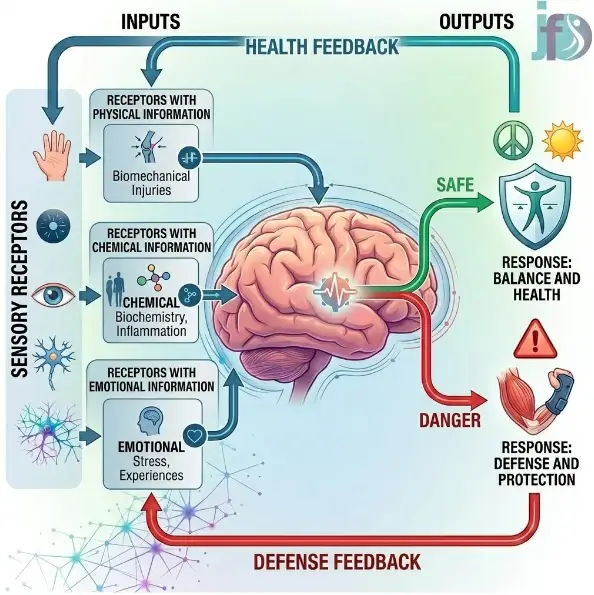
What are dysfunctions?
In the most advanced clinical context, we refer to these communication failures between your body’s sensory receptors and your brain as dysfunctions. When a peripheral sensor malfunctions, it sends incorrect information, and the brain makes erroneous motor decisions based on that faulty data; let’s take a simpler example: a delivery deadline in a company. Department A sends information to Department B with a mistake in the delivery deadline – instead of being Monday of that same week, it is listed as the following week – resulting in Department B missing the deadline, along with all the potential negative consequences of late delivery.
Returning to our bodies, if you focus solely on soothing the painful area to eliminate pain, you will only achieve temporary relief. To address the communication breakdown at its root, we – qualified professionals specialising in pain relief using P-DTR functional neurology in Madrid – place emphasis on all the factors affecting the patient in this regard.
The nervous system and chronic pain
When we suffer an injury, a blow or even surgery, the thousands of sensory receptors – also known as neuroreceptors – distributed throughout our body can become severely dysregulated. Although the physical and structural tissue heals completely over the course of several months, these disrupted receptors continue to send a constant and completely disproportionate electrical warning signal to your brain, fuelling chronic pain.
When you are constantly exposed to this false threat, your nervous system reacts in the only way it knows how to protect you: by tightly tensing the surrounding muscles (hypertonia), drastically limiting your range of motion and causing that familiar, unpleasant sensation of chronic pain. It is a symptomatic cycle that is very difficult to break if we focus solely on massaging or relaxing the contracted muscle, rather than assessing which muscle is failing to do its job. It is precisely for this reason that the P-DTR neuroreceptor therapy approach is so tremendously effective for patients. Rather than trying to mechanically force the muscle tissue to relax, the P-DTR method allows us to communicate in the same language as the nervous system to eliminate your pain at its root.
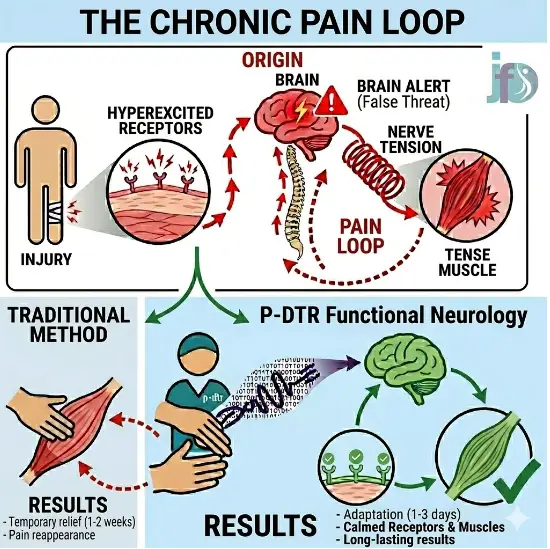
Treating relapses with P-DTR functional neurology
I’m sure this frustrating situation sounds all too familiar: you go for your treatment session, notice a marked improvement over a couple of days, but when you try to go back to the gym, go for a run or simply make a sudden movement at home, you feel a sharp twinge and find yourself back in the same painful situation as before. We call these constant and demotivating setbacks ‘relapses’. These painful relapses are the main and clearest clinical indicator that the neurological cause of your motor problem has not been resolved at all.
When you live with chronic pain on a daily basis, your body completely loses its natural ability to react in time to unexpected physical events. In other words, if your stabilising muscles do not receive the signal via the nervous system at the precise millisecond due to a delay in the signal, your joints are left completely unprotected against the load. It is possible to eliminate pain with P-DTR in Madrid by utilising functional neurology, as this methodology ensures that this afferent communication is re-established and functions correctly once more. The P-DTR methodology ensures that your body responds swiftly once more, eliminating dysfunctions at their neurological source. It enables us to assess how you walk, the condition of your organs, whether you are experiencing related emotional issues, and which exercises are beneficial or harmful to you.
Pain assessment using P-DTR
One of the biggest and most common mistakes in many conventional treatments is the repetitive application of entirely generic protocols without taking the time to investigate why this particular person’s body is mounting a defence. Every person has their own personal history, which is why the clinical use of P-DTR functional neurology to pinpoint dysfunctions is vital. We carry out a personalised, dynamic and highly accurate assessment using myotatic reflexes.
At the P-DTR functional neurology clinic in Madrid, we do not put strain on your painful joints; instead, we test your nervous system to identify exactly which group of receptors is malfunctioning and causing that severe chronic pain. This meticulous assessment is the cornerstone of P-DTR neuroreceptor therapy. Often, a persistent knee problem is directly caused by a faulty signal that originated years ago in an old scar. If we do not use functional neurology to identify its true source, the biomechanical compensations will remain latent for the rest of your life. Those who successfully eliminate pain with P-DTR in Madrid know that an accurate diagnosis is the most important step in their recovery.
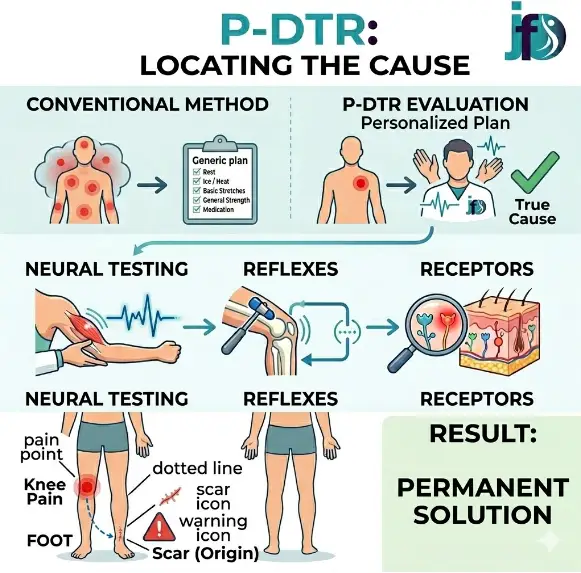
Pain relief with P-DTR in Madrid
A firm commitment to a therapeutic approach grounded in functional neurology makes a significant clinical difference between temporary relief and a profound, holistic and lasting recovery. The cutting-edge approach of P-DTR neuroreceptor therapy does not, under any circumstances, settle for merely masking troublesome symptoms. By targeting neurological dysfunctions directly, we achieve biomechanical results that are much faster, more predictable and more stable over time, thereby avoiding frustrating muscle relapses.
As the patient experiences this improvement, which alleviates their chronic pain, they instantly understand why their body was reacting in such a limiting way and lose their fear of movement. Living with chronic pain should never be something you get used to or accept as normal in your day-to-day life. Thanks to the incredible and constant advances in functional neurology, we now know that we can retrain the nervous system to curb these altered bodily responses. Your body possesses an enormous and valuable capacity to adapt. By providing it with the correct sensory input through P-DTR, we give it the opportunity to restore normal function to your tissues, heal chronic dysfunctions and prevent relapses once and for all.
Our main aim during a consultation is always to identify and correct the root cause of your problem with complete clinical precision. If your aim is to eliminate pain with P-DTR in Madrid, don’t hesitate to take the step towards a treatment that truly respects your physiology. Say goodbye for good to discomfort and constant pain, place your full trust in the science of your own body, and get ready to eliminate pain with P-DTR in Madrid once and for all, regaining your wellbeing, putting an end to suffering, and permanently removing pain from your daily life.
Did you enjoy the content?
Follow me on social media or read another article!
If you think someone else might like this… Share it!
Related articles
What is P-DTR?
What is functional neurology?
Why nobody can cure your chronic pain
Information
Phone
+34 621 079 216
joaquinferrer.fisio@gmail.com
Address
Av. Ángel Nieto, 8, 28660 Boadilla del Monte, Madrid
