Why can’t I fully recover from my ACL injury?
Have you had an operation months ago and done all sorts of exercises, but feel that your knee still isn’t working as it should? It’s very frustrating to feel that you’ve reached a plateau and that the chronic pain and flare-ups won’t go away, no matter how much you follow the specialists’ advice.
In this article, we’re going to clearly explain the real reasons why your recovery is being held back. It’s not that you’re not trying hard enough; it’s that your nervous system and your anterior cruciate ligament aren’t communicating properly.
Find out why the standard approach to LCA falls short and how we can tackle this problem at its root so that you can get back to training, playing or simply living without pain or fear of a relapse, by resolving that troublesome dysfunction that holds you back every day.
The neurological impact of the Anterior Cruciate Ligament
Undergoing surgery to repair your anterior cruciate ligament is just the first step on a rather demanding journey. Many athletes and patients find that, after surgery, there comes a point when the knee can no longer cope with the demands of training, or they simply suffer a relapse during the process. You are left with chronic pain that won’t go away, and rehabilitation seems to have reached its limits. To understand what is happening, we need to stop focusing solely on the joint tissue and start paying attention to how your body is managing this problem.
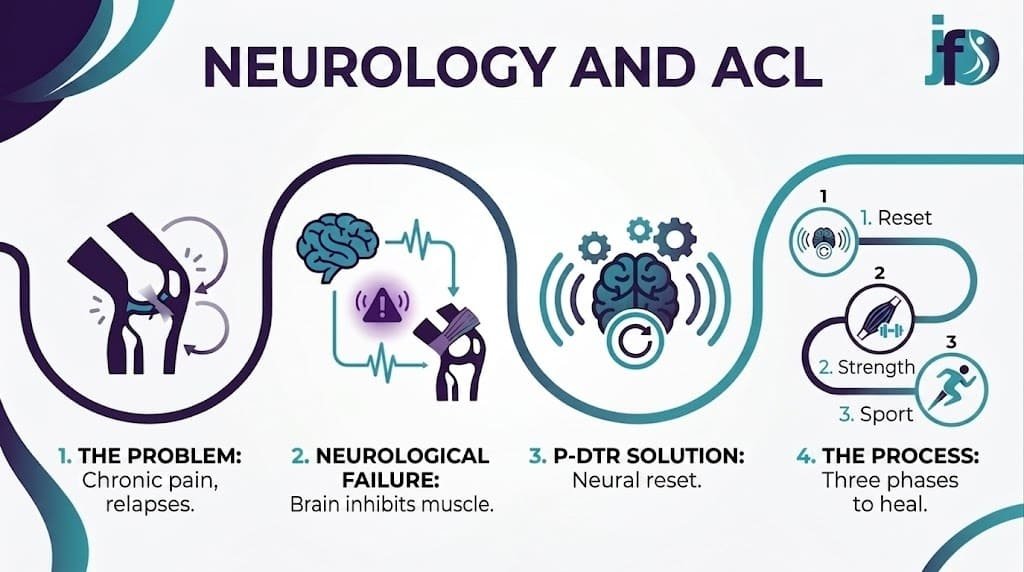
When you tear your ACL, the damage goes far beyond a simple tear in the structure. At that moment, thousands of nerve sensors (neuroreceptors) are damaged, and your brain goes into a state of high alert. This breakdown in communication is the main reason why you continue to experience chronic pain long after the doctor has discharged you. We need to understand that the anterior cruciate ligament is a structure teeming with sensors that inform your brain of the exact position of your leg. If these sensors malfunction, your brain inhibits the muscles of the knee as a simple precaution. And whilst the structure may have healed, the brain may continue to perceive a threat.
This is where the functional neurology provides us with the missing answers. By assessing your nervous system, we can identify exactly which muscles and receptors are failing. Using the P-DTR methodology, we identify that problem in the joint, muscle or ligament neuroreceptors and correct it. Working on this neurological aspect is a key part of your rehabilitation, because if your brain continues to detect danger, your knee will be subjected to enormous strain, and the likelihood of another recurrence will increase significantly as soon as you return to proper sport. So, to begin a good rehabilitation programme, the foundation would be to start by using P-DTR functional neurology to work on your entire system to desensitise it, so that strength training or other physiotherapy techniques subsequently make sense and we can maximise their results.
The muscles that become inhibited following ACL surgery
That state of alertness we were talking about causes your body to react in order to protect the operated anterior cruciate ligament. The most common reaction is muscle inhibition. Basically, your brain restricts the electrical signal to the quadriceps muscle in your operated leg. It does this deliberately so that you cannot make rapid movements that might put your knee at risk, but in the long run this leads to chronic pain due to the resulting weakness and lack of muscle contraction. Furthermore, in the tendon or tendons where the graft is attached, this often causes the tendon to become hypertonic, leading to tendinitis or inflammatory pain.
Alongside the inhibition of the quadriceps, this dysfunction causes the hamstring muscles in your other leg to be reflexively inhibited as well. Ultimately, this alters your gait, leads to poor weight distribution and results in discomfort in your back or hip. If we do not address this lack of activation using P-DTR functional neurology, you will become frustrated lifting weights at the gym or running without achieving lasting improvements. Thanks to P-DTR neuroreceptor therapy, we are able to reactivate or relax these muscles so that they move as they should. Only in this way – with truly healthy muscles throughout your rehabilitation – will your knee be protected from impact and you’ll be able to put any recurrence behind you.
How does a patient’s medical history affect ACL surgery and rehabilitation?
Your medical history matters far more than you might think when it comes to the anterior cruciate ligament. Any previous injuries you’ve had and any scars on your body completely alter the way you move and how your muscles engage. The surgical incision made during ACL surgery itself creates a scar that alters tissue tension and skin sensitivity. That exact spot sends constant warning signals to the brain, providing further reasons to maintain that active chronic pain.
If, on top of that, you’ve had an operation for appendicitis in the past, broken a bone or suffered repeated sprains, your body was already dealing with one or more underlying problems. When you now add an anterior cruciate ligament tear to this, your nervous system becomes overwhelmed with afferent information and you start to experience pain in distant areas that were previously fine. That is why, as part of a good rehabilitation programme, it is essential to assess and treat these scars in a specific and personalised manner.
Using functional neurology and the P-DTR methodology, we are able to desensitise the scarred area. The aim is to stop that area from sending out danger signals that restrict your muscles. If we ignore your medical history, the new ACL tissue will have to withstand forces it is not designed to handle. This lack of control over movement is what increases the risk of a recurrence when you try to change pace or jump on a sports pitch.
Types of plasty and how they affect the Anterior Cruciate Ligament
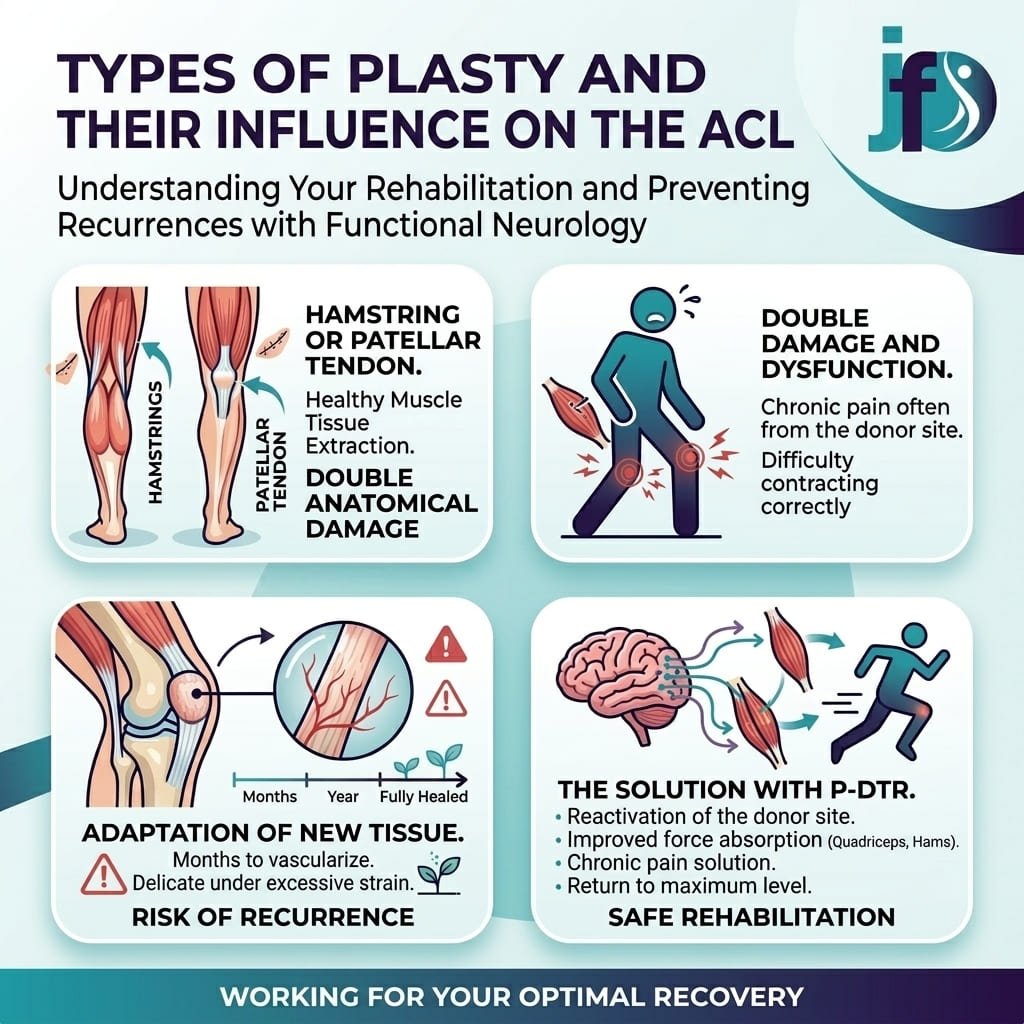
The type of tissue the surgeon chooses to create your new anterior cruciate ligament has a significant impact on your recovery time. The most common approach is to use a graft from your own hamstrings or patellar tendon. This means that, in order to repair the knee, an incision must be made in a muscle that, until that day, had been perfectly healthy.
Because of this dual anatomical damage, it is very common for the chronic pain you experience in the first few months not to come from inside the knee, but from the muscle from which the tendon was taken, which now has significant difficulty contracting properly. This new tissue takes months to adapt and develop a blood supply, and during that time, your ACL is very vulnerable to overexertion.
If you start doing high-intensity exercise without having good control over your movements, you’re very likely to suffer a relapse. Here, once again, functional neurology can help us assess how your body is coping with the absence of that section of tendon. Working with P-DTR, we help your nervous system to reactivate that ‘donor’ muscle group, improving the way your quadriceps or hamstrings absorb force. Doing this safely is crucial to your rehabilitation, as it is the only way to resolve chronic pain and return to performing at your very best.
Changes in the coordination pattern
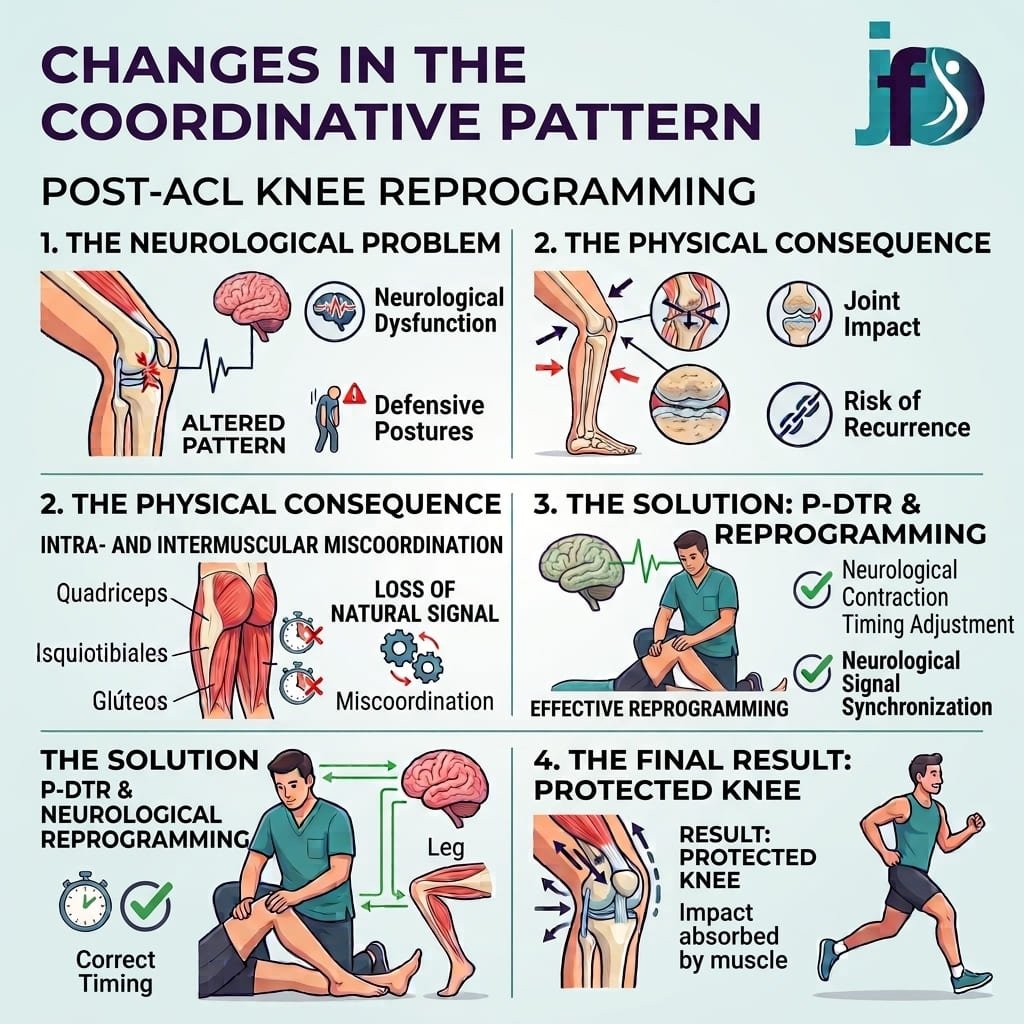
Tearing your Anterior Cruciate Ligament disrupts the natural way your body used to move. When you notice instability in your knee, your nervous system adopts defensive postures almost instantly. The problem is that, if you maintain these altered postures for too long, you’ll end up developing chronic pain that severely limits your mobility. For your knee to cope well with physical activity, your brain needs to restore its original motor pattern.
This neurological dysfunction causes you, without realising it, to alter the way you walk, run or jump in an asymmetrical manner. All of this subjects your joint to very damaging forces. At this stage of rehabilitation, functional neurology is key to reprogramming how your leg responds to gravity. With the appropriate P-DTR corrections, we can eliminate these movement abnormalities and restore fluidity to your stride. If you start doing hypertrophy training without correcting this first, you will wear down the cartilage prematurely, directly increasing the likelihood of a recurrence.
Intermuscular and intramuscular coordination
To put it simply, intramuscular coordination is your brain’s ability to activate all the fibres of a single muscle at the same time. Following Anterior Cruciate Ligament surgery, this electrical capacity decreases dramatically due to inflammation and the chronic pain that has set in. On the other hand, intermuscular coordination is the ability to activate various muscles in the leg in the exact order required to perform a more complex joint movement.
ACL surgery significantly affects both of these factors. As a result, you develop a significant dysfunction where your muscles react with a delay of a few milliseconds. If you try to lift heavy weights without addressing this, you will create constant friction inside the knee, bringing your progress to an abrupt halt.
If we analyse these activation faults using functional neurology and treat them with P-DTR, we can fine-tune those contraction times perfectly. When we get your quadriceps, hamstrings and glutes to work together precisely as a team, the force of the impact is absorbed by the muscle and does not reach the joint. It is this progress in your rehabilitation that truly protects your anterior cruciate ligament, eliminates the strain causing your chronic pain and prevents any recurrence when you resume your training.
Overload of the proprioceptive system
The Anterior Cruciate Ligament (ACL) in any healthy person contains thousands of neuroreceptors that continuously send information to the brain about the speed and angle of the knee. We call this transmission of data ‘proprioception’. When you tear your ACL, you suddenly lose that sensory information. To compensate for the lack of data from the knee, your brain begins to rely excessively on the visual system and the inner ear.
For this reason, it is very common that if you are experiencing chronic pain following surgery, you rely heavily on your sight to maintain your balance. If you try to stand on one leg and close your eyes, you will notice that you lose your balance immediately. This sensory dysfunction demands a great deal of attentional energy from your brain. Prescribing exercises on unstable platforms as part of your rehabilitation without first reducing this excessive reliance on sight is a clear methodological error.
Using functional neurology, we accurately assess the extent to which your eyes are trying to compensate for the lack of information from your knee. Using P-DTR, we readjust this information input to force your nervous system to utilise the residual sensors in the operated knee. Relieving this strain on your eyes exponentially reduces the risk of a recurrence, enabling the new anterior cruciate ligament to regain full functionality and eliminating the underlying cause of your chronic pain.
How to make a full recovery from an ACL injury
As you’ve seen, healing your knee involves much more than just doing generic strength exercises. If you’ve been undergoing rehabilitation for months and are still stuck with constant chronic pain that’s holding you back, your nervous system needs a different approach. Continuing to put strain on the joint whilst there is an active motor control dysfunction will only drastically increase the risk of you suffering a further structural recurrence in your anterior cruciate ligament.
Don’t just put up with these daily discomforts or be forced to lower your sporting performance. We are experts in identifying and correcting these neuromechanical faults using functional neurology. Through the precise assessment provided by the P-DTR system, we normalise your brain’s signals so that your ACL can finally adapt to physical exertion, eliminating the chronic pain that holds you back so much right at its neurological source.
If you really want to put your frustration behind you, avoid any relapse and get back to enjoying your training and your life to the full, now is the time to entrust your rehabilitation to experts. Contact us to assess your case on a fully personalised basis. We will address this limiting problem to restore the stability and confidence you need to your body and your knee.
Did you enjoy the content?
Follow me on social media or read another article!
If you think someone else might like this… Share it!
Related articles
How can I stop my pain from coming back?
Why nobody can cure your chronic pain
When is online rehabilitation better?
Information
Phone
+34 621 079 216
joaquinferrer.fisio@gmail.com
Address
Av. Ángel Nieto, 8, 28660 Boadilla del Monte, Madrid
